AndrBel
Contemporary Conceptual Artist | Cognitive Structuralism AndrBel
ARTHALL BEL4224
Artistic Continuity Infrastructure:
Why Artistic Legacy Requires Governance Infrastructure
Abstract
Contemporary artistic practice increasingly operates as a complex system of artworks, archives, concepts, legal structures, collectors, institutional relationships, and market circulation. Yet the mechanisms designed to preserve artistic legacy remain largely passive, fragmented, and retrospective.
This paper introduces the concept of Artistic Continuity Infrastructure as a governance-based framework for sustaining artistic legacy across time. While archives preserve information, they do not ensure continuity. Artistic continuity requires structured roles, succession logic, institutional custodianship, provenance governance, and operational systems capable of preserving not only artworks, but the relationships and structures that give them meaning.
The paper argues that the central challenge of artistic legacy is not only preservation, but continuity governance. It proposes a model connecting the Artist, Successor, Artistic Legacy Representative, Institutional Custodian, and the wider ecosystem of markets, institutions, and collectors.
Through this framework, artistic legacy is repositioned as an active infrastructure problem rather than a passive archival concern.
Keywords
Artistic Continuity Infrastructure
Artist Legacy Infrastructure
Governance Infrastructure
Artistic Legacy
Institutional Custodianship
Artistic Legacy Representative
Successorship
Provenance Systems
Archive Continuity
Cultural Transmission
MADO cod ART
ARTHALL BEL4224
Institutional Custodian
Successor
Legacy Representative
The Global Artistic Continuity Infrastructure
1. Introduction — The Continuity Problem
Artists create works, but artistic legacy does not survive through works alone.
A painting may remain physically intact.
A sculpture may enter a collection.
A digital file may remain stored in an archive.
Yet the artistic system around these works can still collapse.
The archive may fragment.
The provenance chain may weaken.
The conceptual structure may become inaccessible.
The family may lack the knowledge or capacity to manage the estate.
The market may continue without governance.
Institutions may lose contact with the broader logic of the practice.
This reveals a fundamental weakness in the contemporary art ecosystem:
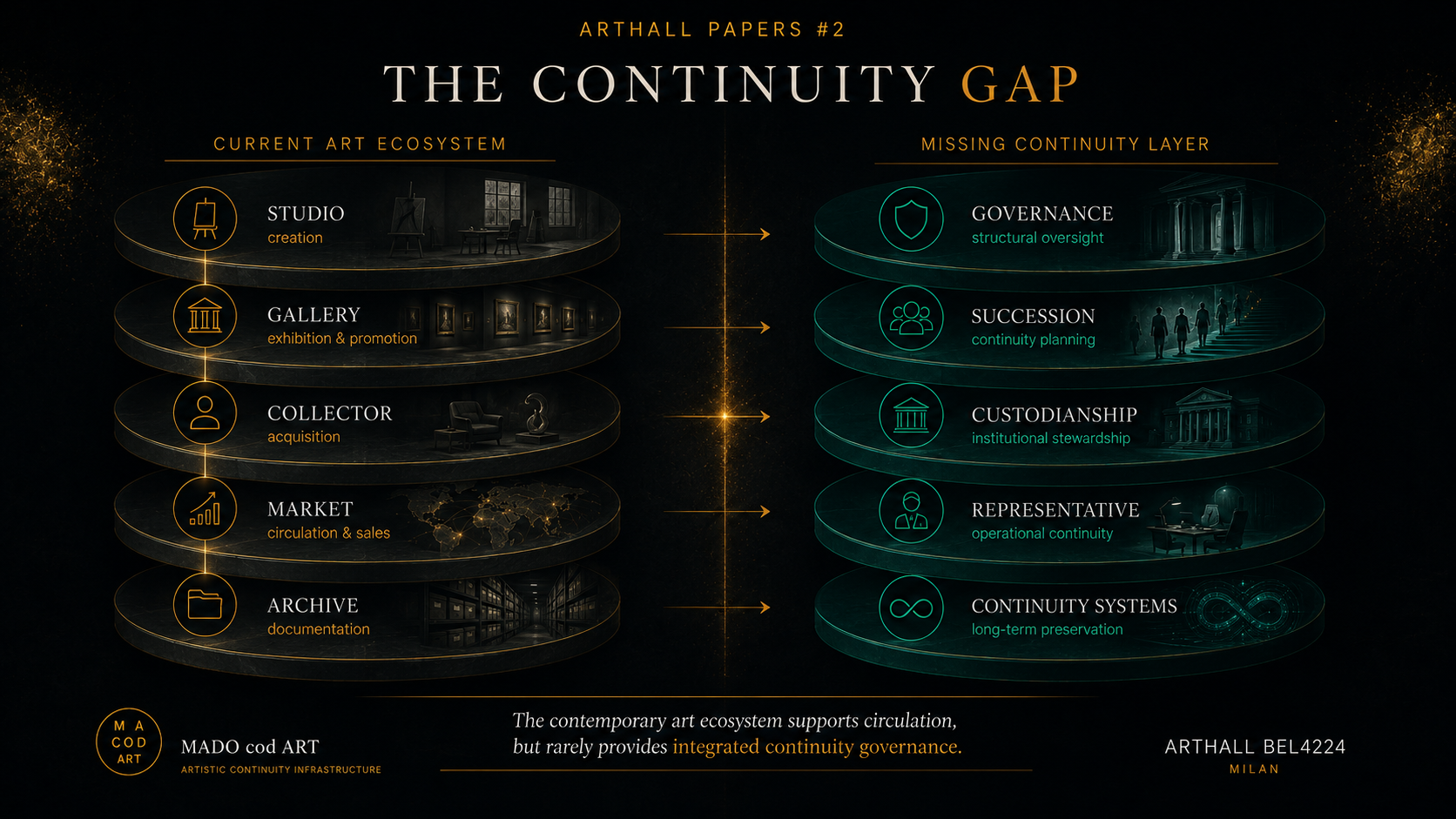
The art world has developed systems for circulation, but not systems for continuity.
Galleries sell.
Museums collect.
Archives preserve.
Collectors acquire.
Markets circulate.
But artistic continuity requires more than circulation, preservation, or ownership.
It requires governance.
This paper proposes the concept of Artistic Continuity Infrastructure as a structural framework for maintaining artistic legacy across generations, institutions, and cultural systems.
The central question is:
Under what conditions can an artistic practice continue coherently beyond the artist’s direct control?
This question becomes urgent in contemporary art, where artistic practices are increasingly systemic. Many artists no longer produce isolated objects. They develop conceptual systems, digital extensions, archive structures, theoretical frameworks, and long-cycle bodies of work.
When such practices lose continuity, the loss is not only material.
It is structural.
2. The Collapse of Artistic Systems
The death of an artist is often treated as a biographical event.
Structurally, however, it is a continuity crisis.
When the artist is no longer present, the artistic system loses its central point of interpretation, decision-making, and authority.
The problem is not only emotional or legal.
It is operational.
Who controls the archive?
Who confirms authenticity?
Who interprets unfinished work?
Who manages collectors?
Who communicates with institutions?
Who protects the market?
Who maintains the conceptual framework?
Who decides what should remain private, public, exhibited, sold, or withdrawn?
In many cases, these questions remain unanswered until it is too late.
As a result, artistic systems fragment.
This fragmentation may occur across several levels:
- Archive fragmentation — documents, images, and records become dispersed.
- Provenance fragmentation — ownership histories become unclear.
- Conceptual fragmentation — the internal logic of the work becomes inaccessible.
- Market fragmentation — works circulate without pricing or resale governance.
- Institutional fragmentation — museums, curators, and scholars lose a stable point of contact.
- Family fragmentation — heirs may disagree or lack expertise.
This is why artistic legacy cannot be reduced to the survival of objects.
An artistic legacy is not only what remains.
It is how what remains continues to function.
3. Archive Is Not Continuity
The archive has traditionally been understood as the foundation of artistic preservation.
It records.
It stores.
It classifies.
It protects memory.
But the archive is not enough.
An archive can answer:
What exists?
But it does not automatically answer:
Who governs what exists?
How does it continue?
Who has authority?
How is meaning preserved?
How is market coherence maintained?
How is institutional continuity structured?
This distinction is central.
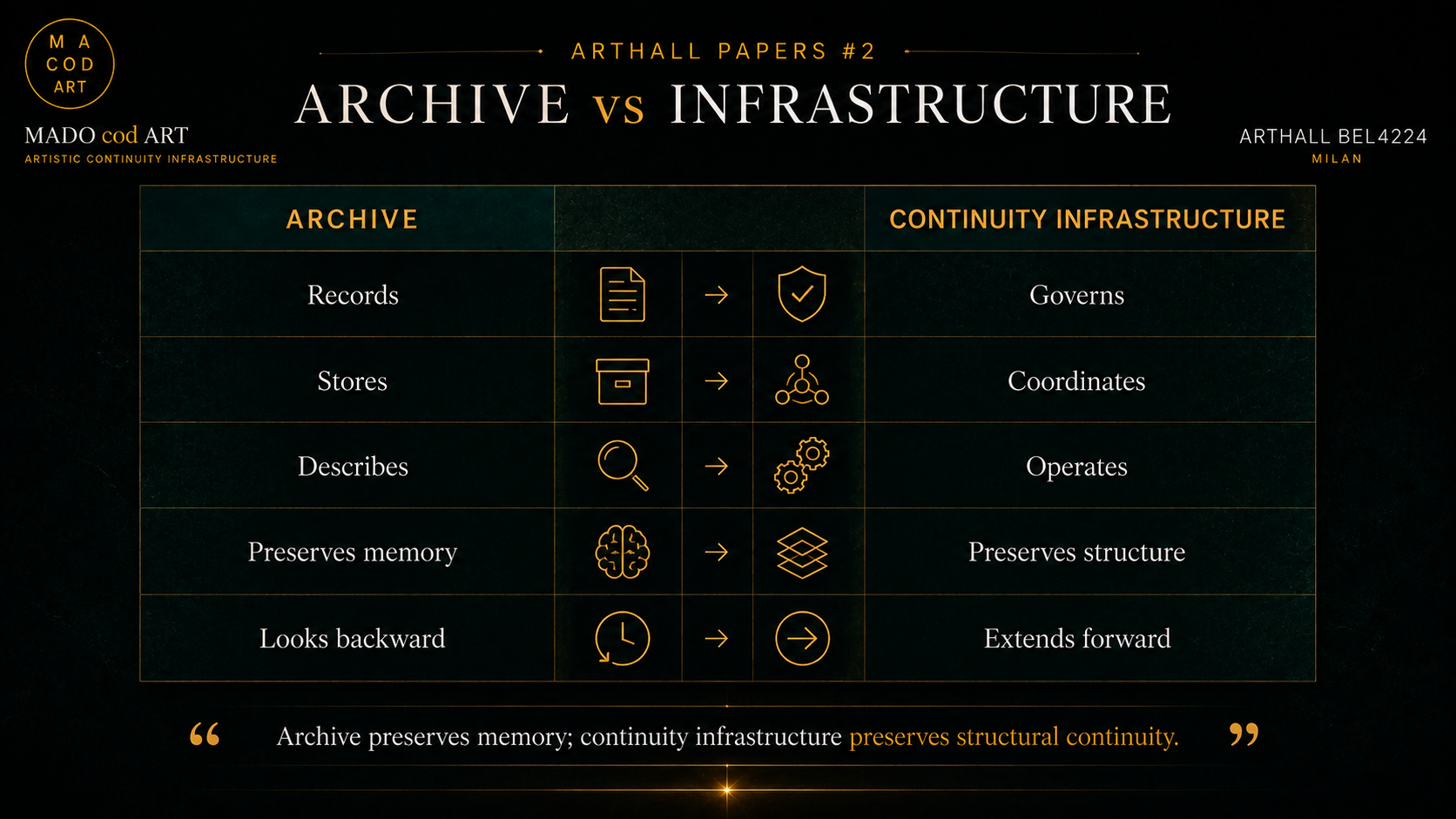
An archive is descriptive.
Continuity infrastructure is operative.
An archive preserves information.
Continuity infrastructure governs relationships.
An archive may store the past.
Continuity infrastructure organizes the future.
Without governance, even a complete archive can become passive.
It may preserve records, but fail to preserve the structure of the artistic practice itself.
This is especially important for artists whose work functions as a system rather than as a collection of separate objects.
In such cases, the archive is not the system.
It is only one layer within the system.
4. From Artist Legacy Infrastructure to Artistic Continuity Infrastructure
The concept of Artist Legacy Infrastructure addresses the structural need to preserve and organize artistic practice beyond the moment of production.
However, legacy is only one part of a broader issue.
The deeper question is continuity.
Legacy often refers to what remains after the artist.
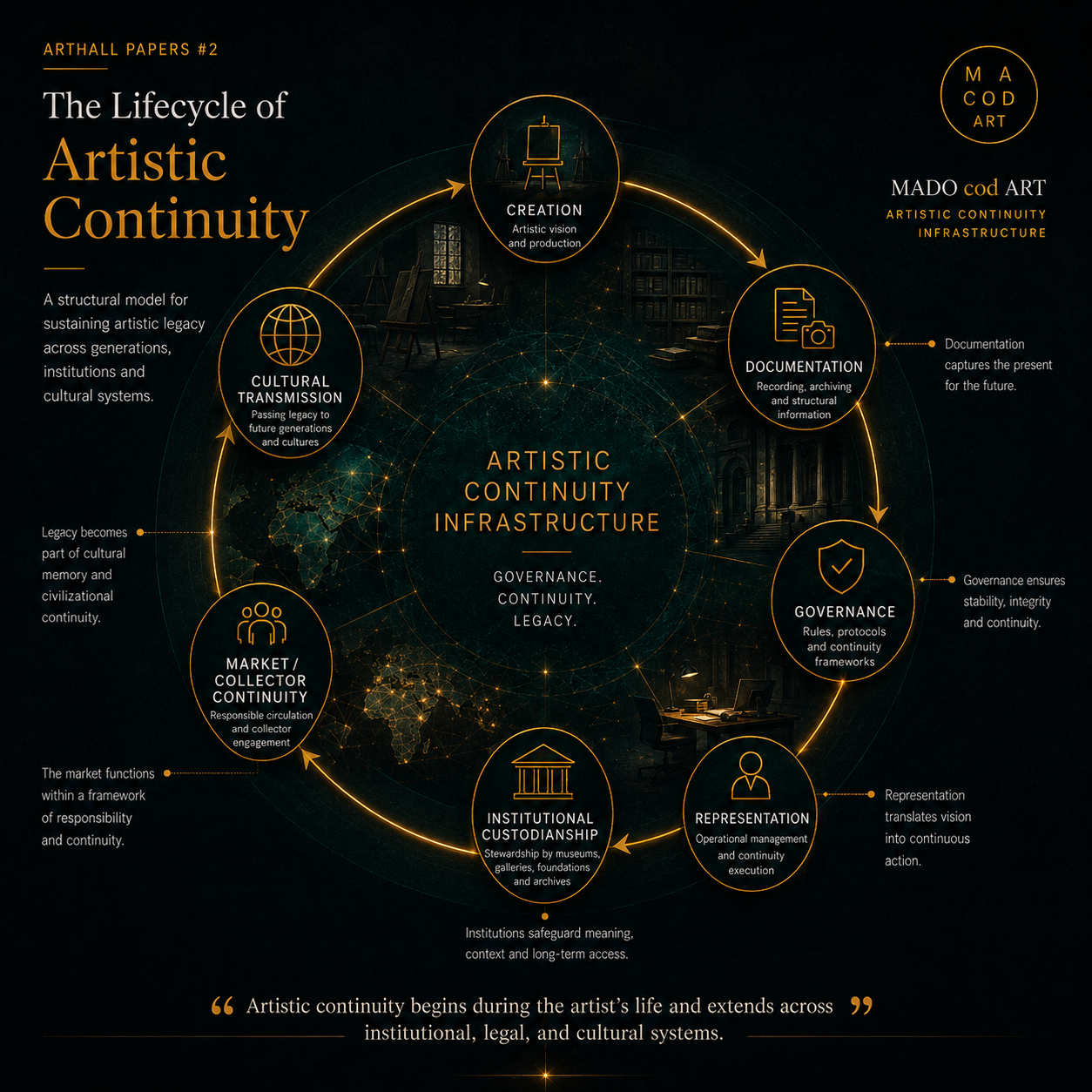
Continuity refers to how the artistic system continues to function before, during, and after that transition.
Therefore, Artistic Continuity Infrastructure expands the model.
It does not begin after death.
It begins during the artist’s life.
An artist at any stage of their creative path should be able to ask:
What is my legacy?
How will my works live?
Who will protect their meaning?
Who will manage their continuity?
How will they be transmitted further?
Artistic continuity is not a posthumous problem.
It is a living structure.
This shift is critical.
The artist does not wait for the future to decide the fate of the work.
The artist begins structuring continuity while still present.
5. Governance Architecture
Artistic continuity requires defined roles.
Without roles, continuity depends on informal memory, personal relationships, and chance.
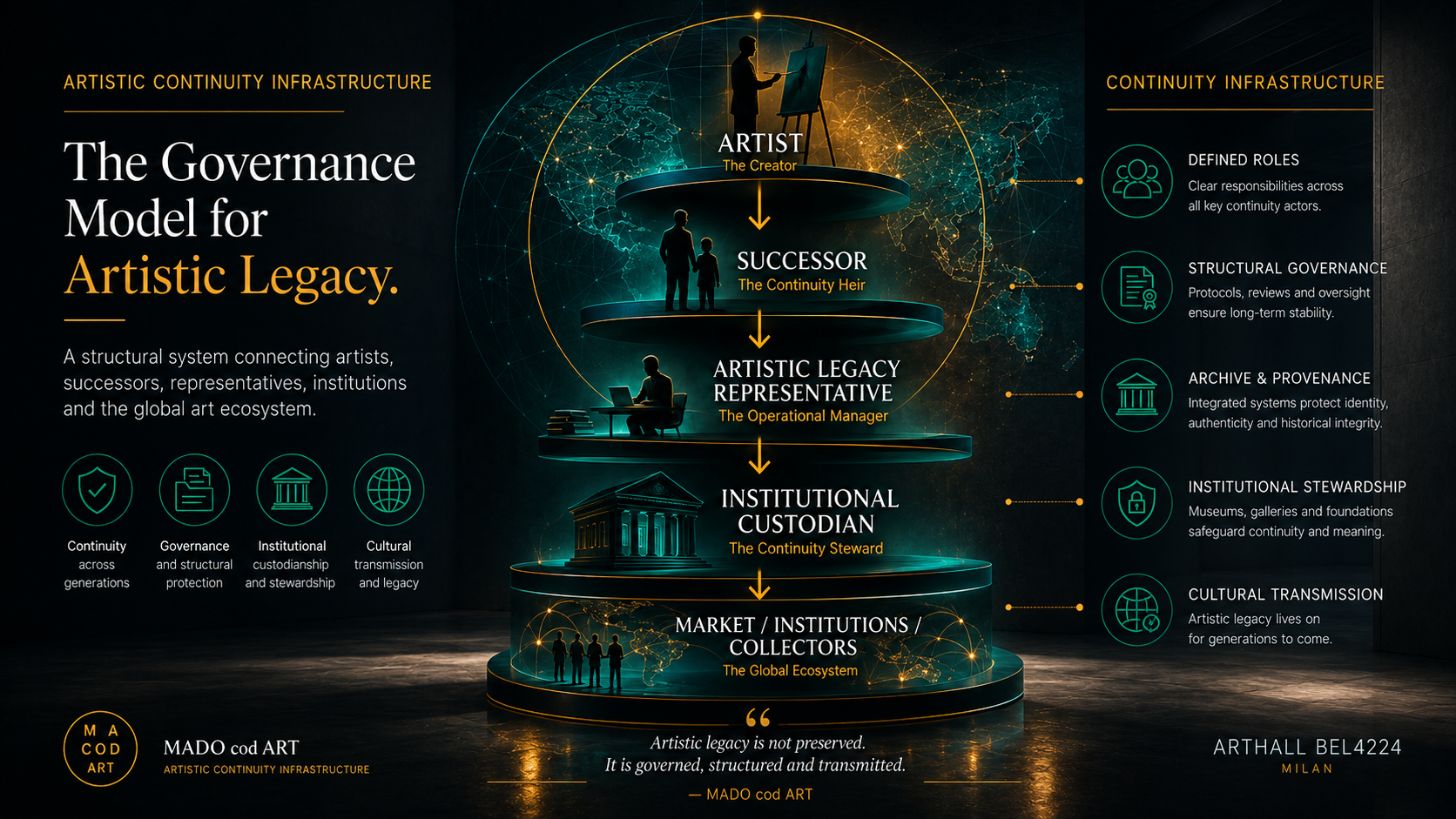
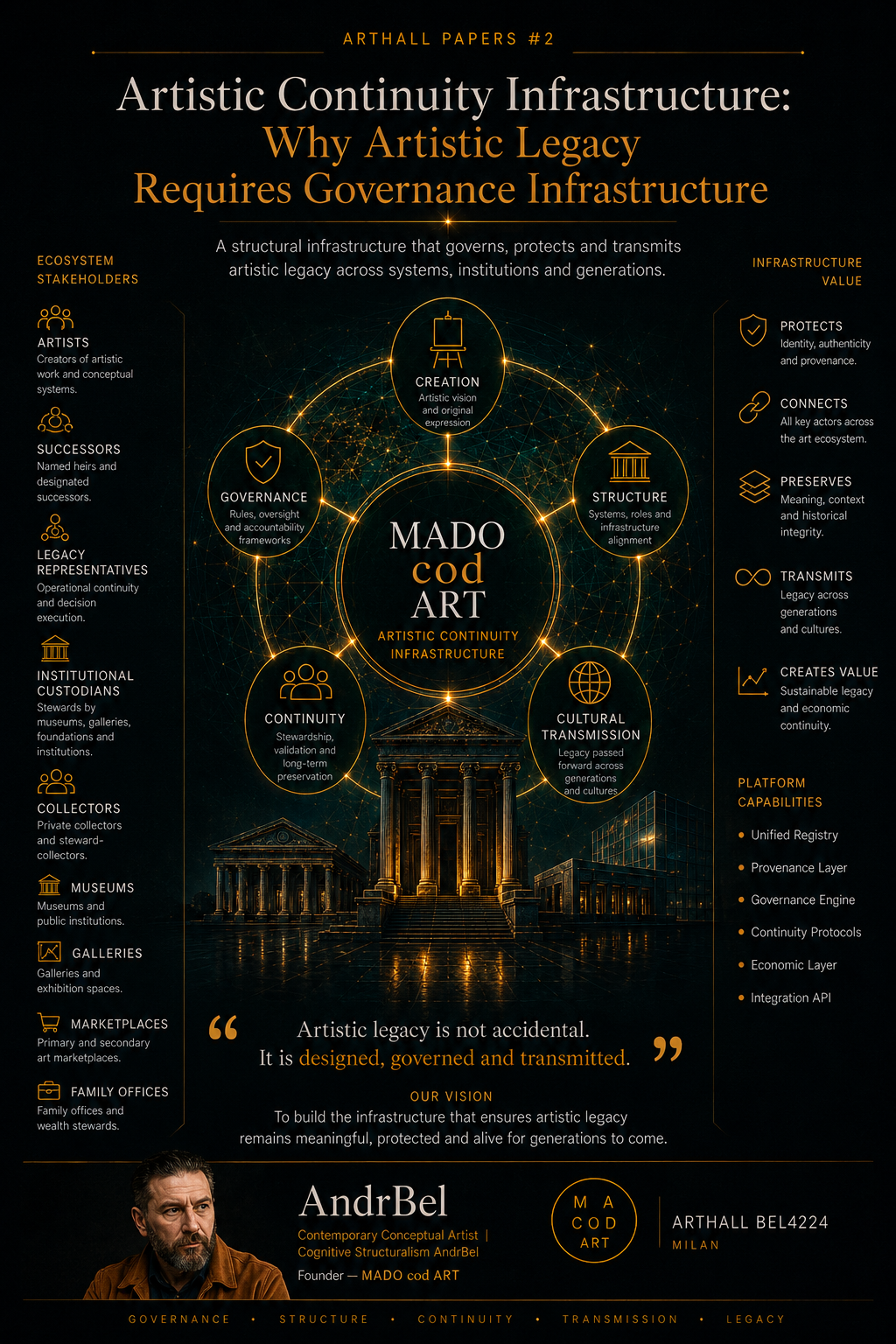
MADO cod ART introduces a governance structure connecting:
Artist
↓
Successor
↓
Artistic Legacy Representative
↓
Institutional Custodian
↓
Market / Institutions / Collectors
This structure does not transfer ownership automatically.
It organizes continuity responsibilities.
Each role has a distinct function.
5.1 Artist
The Artist is the origin of the system.
The artist defines:
- conceptual framework
- archive logic
- artwork hierarchy
- production structure
- preferred continuity path
- authorized representatives
- institutional preferences
- market restrictions
The artist remains the primary authority while alive and capable.
The goal of Artistic Continuity Infrastructure is not to replace the artist, but to help the artist structure the future of the practice.
5.2 Successor
The Successor is the continuity heir.
This role may be assigned to:
- family member
- child
- spouse
- trusted person
- foundation
- legal estate structure
The Successor may inherit legal or moral responsibility for the artist’s archive, rights, artworks, or institutional relationships.
However, succession alone is not enough.
A successor may have legal authority but lack art-world expertise.
This is why the next role becomes essential.
5.3 Artistic Legacy Representative
The Artistic Legacy Representative is the operational continuity manager of the artist’s legacy.
This is one of the central roles in the model.
The Artistic Legacy Representative may manage:
- archive coordination
- communication with collectors
- institutional inquiries
- artwork verification
- exhibition opportunities
- catalogue raisonné development
- market coherence
- documentation updates
- coordination with heirs and institutions
This role should be treated as an official status, not an informal helper.
The Artistic Legacy Representative may be appointed for life, with structured review mechanisms.
Recommended governance logic:
- lifetime appointment
- review every 10 years
- possibility of transfer under defined conditions
- successor override rights under exceptional circumstances
- institutional review when necessary
- documented responsibilities and limitations
This creates continuity without arbitrary control.
5.4 Institutional Custodian
The Institutional Custodian is a museum, gallery, foundation, archive, or qualified cultural institution that assumes long-term stewardship responsibility for an artist’s continuity.
This does not necessarily mean ownership.
Custodianship may include:
- archive preservation
- institutional positioning
- research access
- exhibition coordination
- public interpretation
- provenance support
- conservation protocols
- long-term cultural transmission
The Institutional Custodian becomes a steward of continuity rather than merely a holder of objects.
This is a major shift in how galleries and museums may function in the future.
6. Institutional Custodianship
Museums, galleries, and foundations have historically played essential roles in preserving artworks.
But preservation alone is no longer sufficient.
In the future, institutions may need to become custodians not only of objects, but of artistic systems.
An Institutional Custodian may support:
- continuity of archive
- continuity of interpretation
- continuity of provenance
- continuity of institutional relationships
- continuity of collector communication
- continuity of public access
- continuity of research
This role is especially important for artists whose practices are system-based.
When an artist builds a conceptual architecture, the institution cannot preserve only the object.
It must preserve the relationships that make the object intelligible.
The Institutional Custodian therefore becomes a cultural steward.
It protects not only what the artist made, but how the work continues to function within history.
7. Continuity Stewardship
The concept of custodianship should be understood within a broader idea:
Continuity Stewardship
Continuity Stewardship is the active responsibility to maintain the coherence, accessibility, and institutional life of an artistic system over time.
It may involve:
- legal stewardship
- archival stewardship
- curatorial stewardship
- market stewardship
- technological stewardship
- public interpretation
- cultural transmission
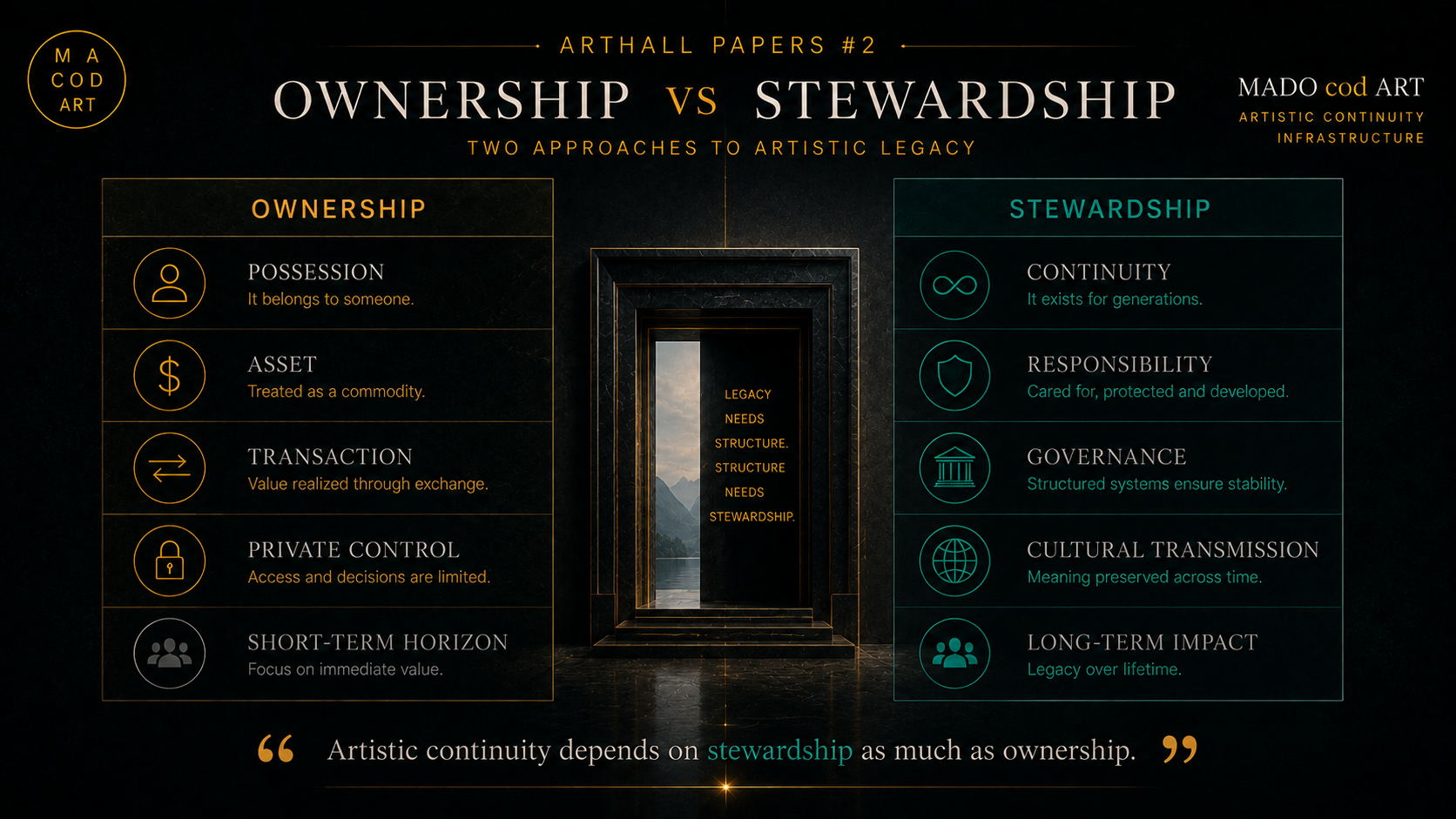
This is different from ownership.
Ownership answers:
Who possesses the work?
Stewardship answers:
Who protects its continuity?
This distinction is critical.
The future of artistic legacy may depend less on possession and more on stewardship.
8. The Continuity Workforce
Continuity requires work.
It does not happen automatically.
A living artistic system requires:
- archivists
- curators
- legal advisors
- provenance specialists
- digital infrastructure
- metadata systems
- AI-supported documentation
- institutional communication
- market governance
- collector coordination
This creates the need for a new kind of workforce:
AI + Human Continuity Workforce
The purpose of this workforce is not to replace cultural professionals.
It is to support long-term continuity at scale.
AI systems may assist with:
- metadata generation
- archive structuring
- document classification
- provenance timelines
- translation
- institutional drafting
- collector communication
- continuity reminders
- system monitoring
Human specialists provide:
- judgment
- legal authority
- curatorial interpretation
- institutional trust
- ethical oversight
- relationship management
Together, they create a hybrid infrastructure for continuity.
This is especially important because most artists cannot afford a full institutional team.
MADO cod ART proposes that artists should be able to access operational structures previously available only to major artists, estates, or institutions.
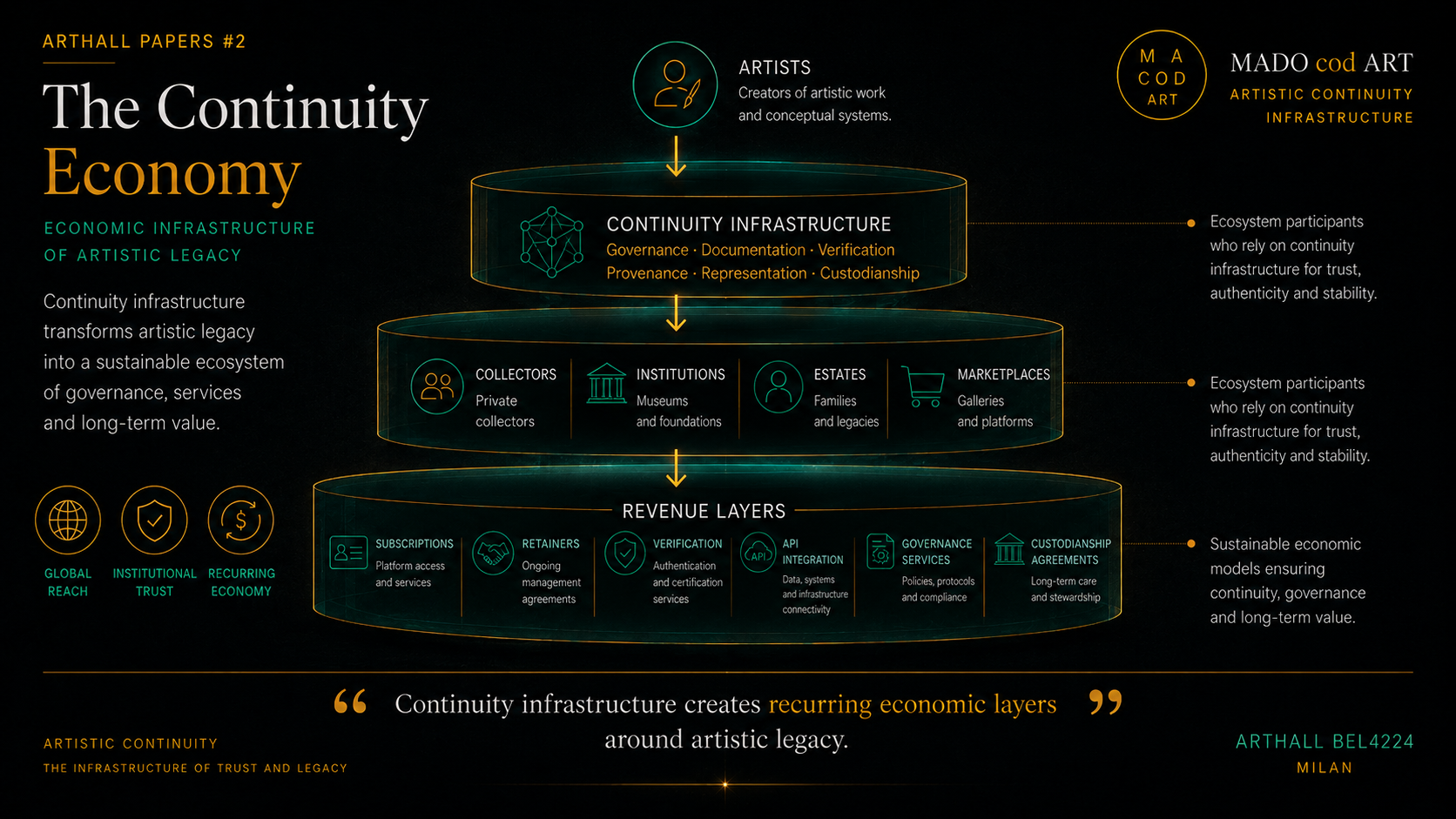
9. Continuity Economy
The art market monetizes circulation.
It monetizes:
- exhibitions
- fairs
- auctions
- private sales
- commissions
- secondary markets
But continuity itself remains structurally unsupported.
Yet continuity creates value.
It supports:
- provenance stability
- collector confidence
- institutional recognition
- market coherence
- archive reliability
- long-term cultural positioning
If artistic value depends on continuity, then continuity itself becomes an economic layer.
This is the foundation of a Continuity Economy.
In such an economy, revenue does not come only from selling artworks.
It can emerge from:
- registry infrastructure
- archive services
- institutional retainers
- collector continuity systems
- estate governance
- API verification
- AI documentation systems
- provenance validation
- custodianship agreements
The continuity economy is not speculative.
It is infrastructural.
It monetizes trust, structure, and long-term cultural reliability.
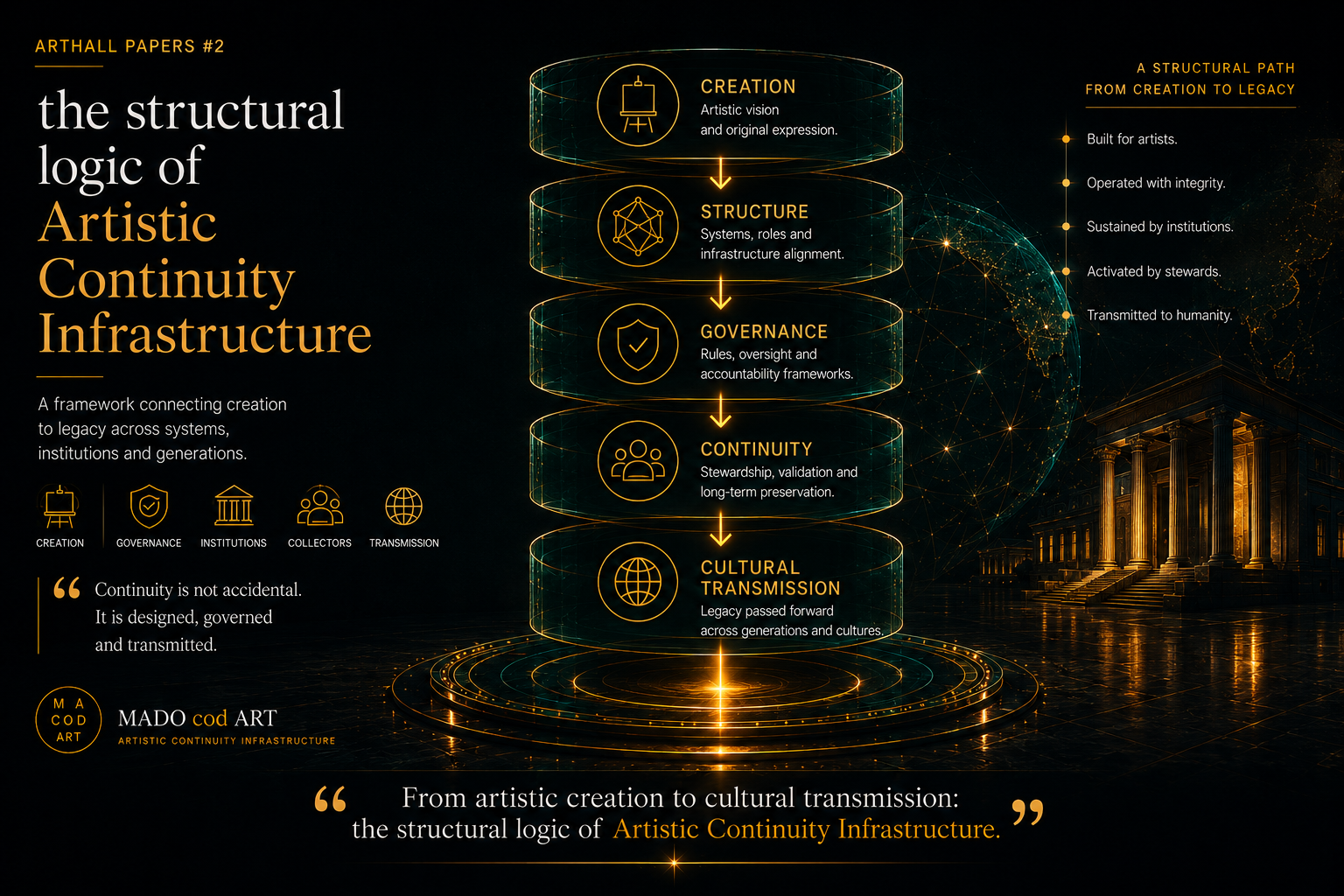
10. MADO cod ART as Infrastructure Implementation
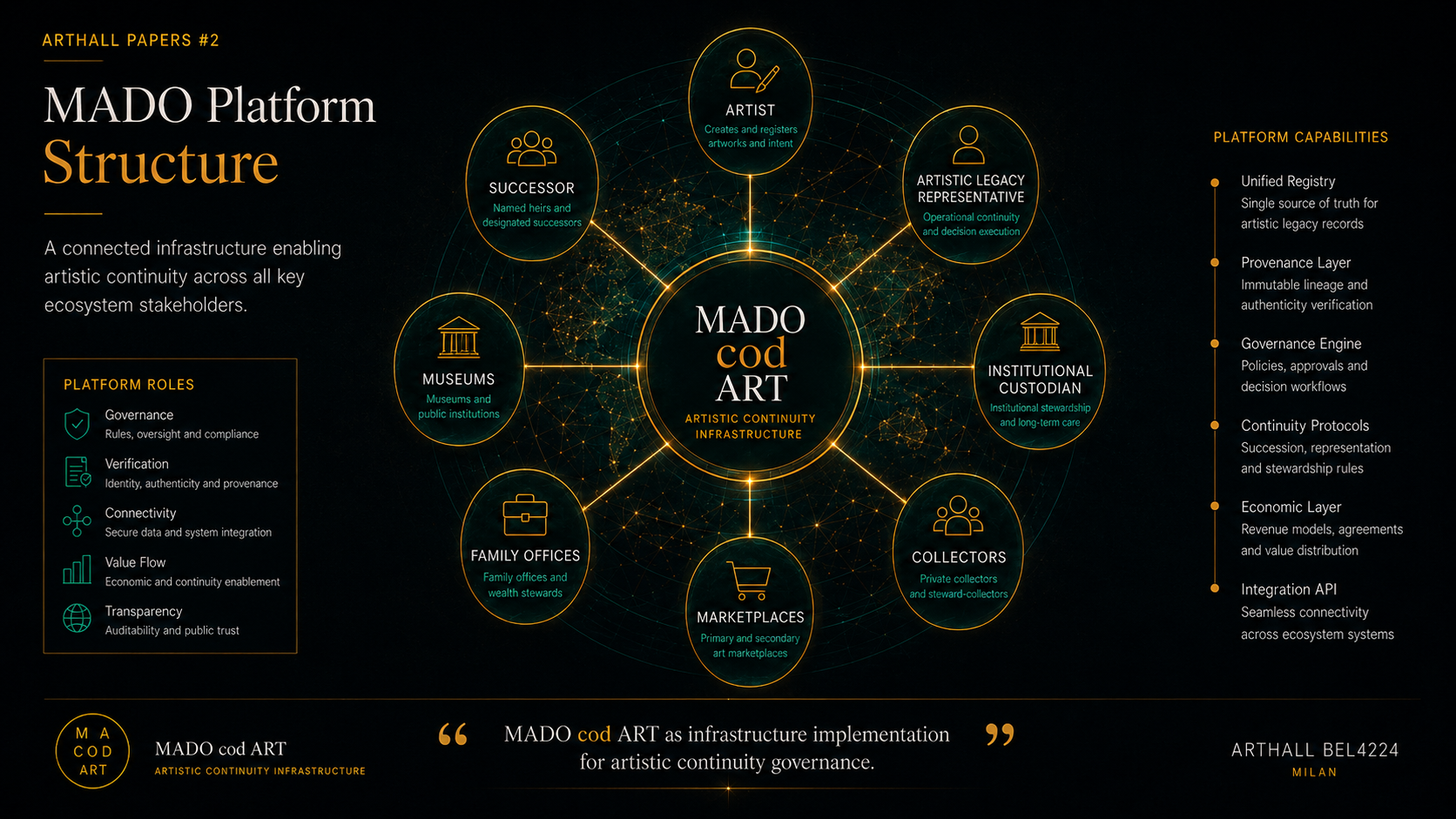
MADO cod ART is not conceived as a marketplace.
It is an infrastructure implementation of Artistic Continuity Infrastructure.
Its role is to connect the fragmented layers of artistic practice into a governed continuity system.
The platform may include:
- Artist Registry
- Artwork Registry
- Archive Infrastructure
- Provenance Systems
- Blockchain Certification
- Documentation Layer
- AI + Human Continuity Workforce
- Successor Management
- Artistic Legacy Representative System
- Institutional Custodian Layer
- Legacy Governance Dashboard
- Collector / Museum / Gallery Access
- Future API Infrastructure
The purpose is not only to document artworks.
The purpose is to structure continuity.
MADO cod ART connects the artist’s practice to the people, institutions, and systems that may preserve its life across generations.
11. Artist-Facing Statement
This section should be more emotional and direct.
Every artist, at any stage of their creative path, should ask:
What is my legacy?
How will my works live?
How will they be transmitted further?
Who will protect their meaning?
Who will preserve their continuity?
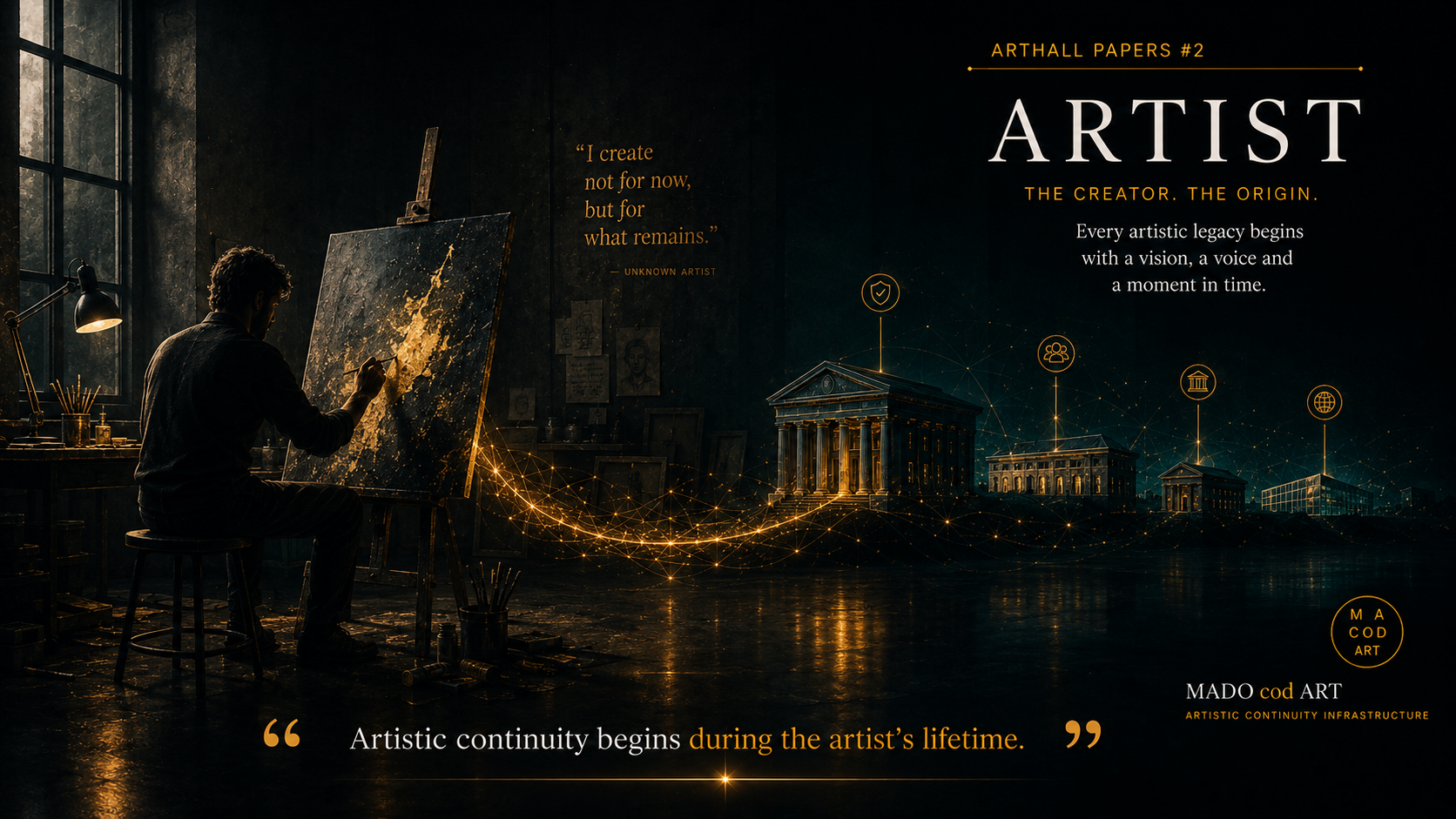
Artistic legacy does not begin after death.
It begins the moment an artist decides to structure continuity.
If an artist is ready to think about this today, MADO cod ART can accompany that path.
The artist should not be alone in facing the future of their practice.
Continuity must be designed.
12. Toward a Future of Artistic Continuity
Civilizations survive through continuity.
They build archives, institutions, legal systems, educational systems, and cultural memory.
Yet individual artists often remain structurally vulnerable.
They create cultural value, but lack the infrastructure to preserve it.
This contradiction defines one of the major unresolved problems of the art ecosystem.
If artistic systems continue to become more complex, digital, conceptual, and global, then continuity can no longer be treated as an afterthought.
It must become infrastructure.
The future of artistic legacy will require:
- governance systems
- succession protocols
- institutional custodianship
- archive continuity
- provenance infrastructure
- AI-supported documentation
- legal and market coordination
- cultural transmission systems
Artistic continuity is not only a private concern of artists and families.
It is a cultural infrastructure issue.
Artists create culture.
Continuity preserves civilization.
Conclusion
The contemporary art ecosystem has developed powerful systems for visibility, circulation, and market exchange.
But it has not yet developed sufficient systems for continuity.
This paper argues that artistic legacy requires governance infrastructure.
Without governance, archives remain passive.
Without succession, authority fragments.
Without representation, continuity weakens.
Without institutional custodianship, artistic systems become vulnerable.
Without infrastructure, legacy becomes unstable.
Artistic Continuity Infrastructure proposes a shift from preserving objects to sustaining systems.
It introduces a governance model that connects the Artist, Successor, Artistic Legacy Representative, Institutional Custodian, and the broader cultural ecosystem.
This model does not replace museums, galleries, archives, or collectors.
It connects them within a continuity structure.
The future of artistic legacy will not depend only on what survives.
It will depend on how continuity is governed.
Artistic legacy does not survive by memory alone.
It survives through continuity infrastructure.
For academic reference, citation is permitted with proper attribution.
Suggested citation:
AndrBel, “Artist Legacy Infrastructure: Why an Artist Needs More Than an Archive,” ARTHALL Papers #1, ARTHALL BEL4224, 2025.
This paper is published within the ARTHALL BEL4224 institutional research framework.
The concepts presented, including Artist Legacy Infrastructure and related structural models, form part of the intellectual property of AndrBel and ARTHALL BEL4224.
Unauthorized commercial use, replication, or derivative development of these concepts is strictly prohibited.